Sigma 30mm F1 4 Art Vs Nikon 35mm F1 8
When the Nikon Z organisation was announced in 2018, much fanfare was made over the new mount which, in addition to existence 55mm in diameter, also has a short flange depth of 16mm. This combination, co-ordinate to Nikon, should allow for a new dimension in optical functioning for current and future eyes.
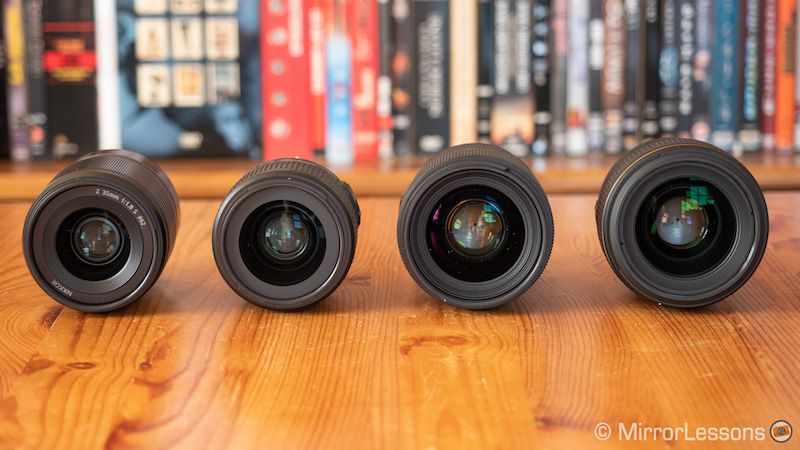
Ane of three lenses launched alongside the new Z cameras was the Z 35mm f/1.8S. Because we had a total month with the lens, we decided to dedicate much of our time to testing it against three of its main competitors for the Nikon F mount, all of which tin be used with full automation* on Z cameras via the FTZ adapter.
Our aim was to encounter merely how far Nikon has pushed the boundaries of optical quality and more importantly, how much of an impact these improvements will have on existent-globe photography. Nosotros hope y'all savor browsing through our findings!
*Note: On the Z7, the EXIF data of certain lens models isn't precise (for instance, both the Sigma and Nikkor 1.four were registered as 35mm ane.4G).
Ethics statement: Nosotros borrowed these four lenses to conduct our comparison on the Nikon Z7. Nosotros were not asked to write annihilation near these products, nor were we provided with any sort of compensation. Within the article, there are affiliate links. If you buy something after clicking the link, we will receive a small commission. To know more well-nigh our ethics, you lot can visit our full disclosure page. Give thanks you!
[toc heading_levels="two″]
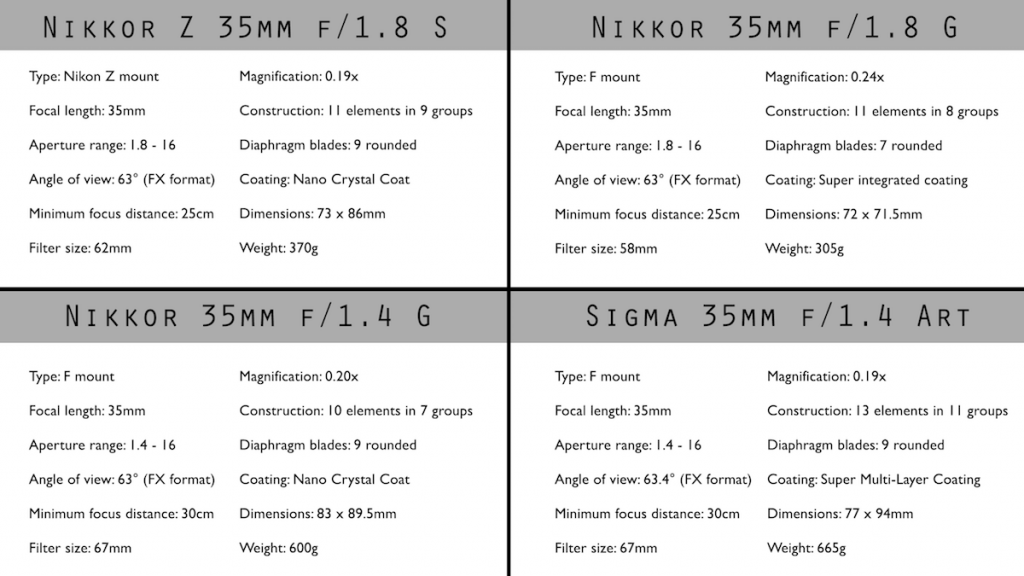
Principal Specifications
Design and ease of employ
The two lenses that are well-nigh similar in size and weight are the one.4 primes from Nikon (600g) and Sigma (670g). They are twice every bit heavy as the 35mm 1.eight One thousand and clearly outweigh the Z 35mm besides.
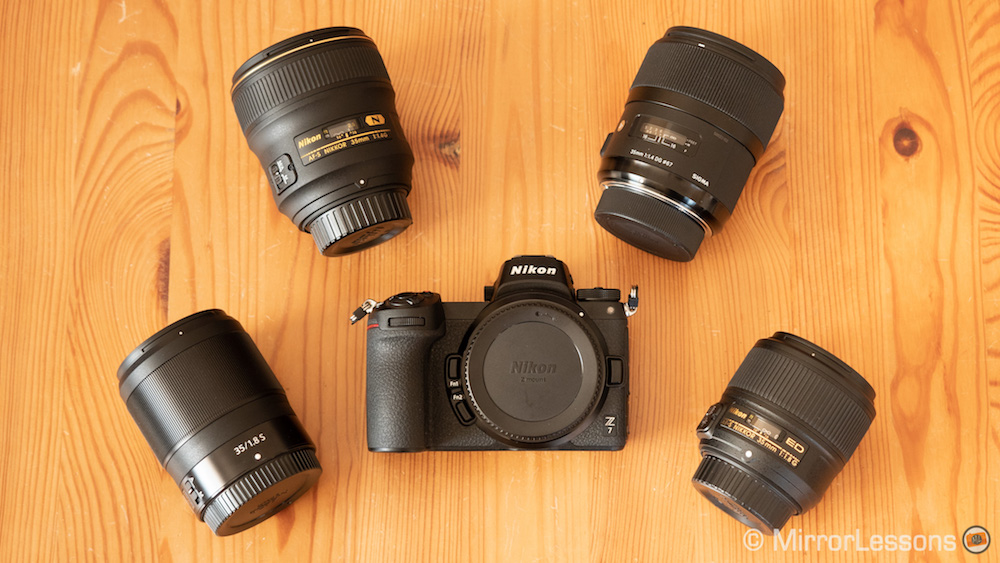
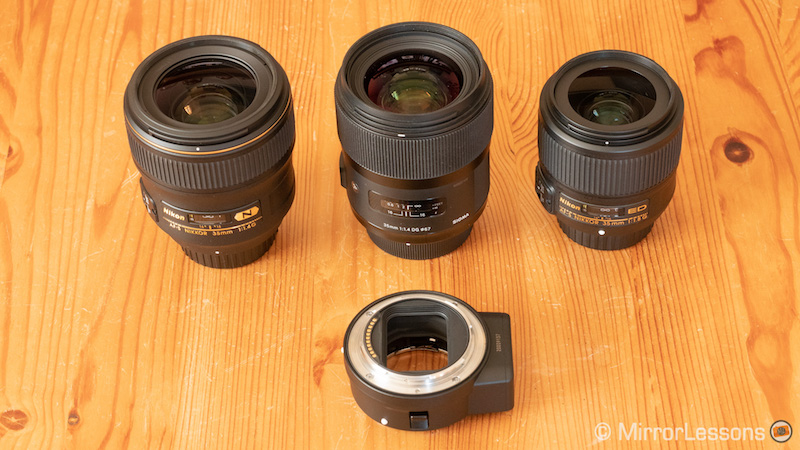
By attaching the FTZ adapter to the 3 DSLR lenses, they all increase in length and weight compared to the Z lens, which is something to consider if yous're looking for the most compact prepare-up possible.
Something I noticed about the two Nikkor lenses is that they are more difficult to attach to the adapter than the Sigma lens. The latter glides on smoothly whereas with the other 2, there is a degree of stiffness.
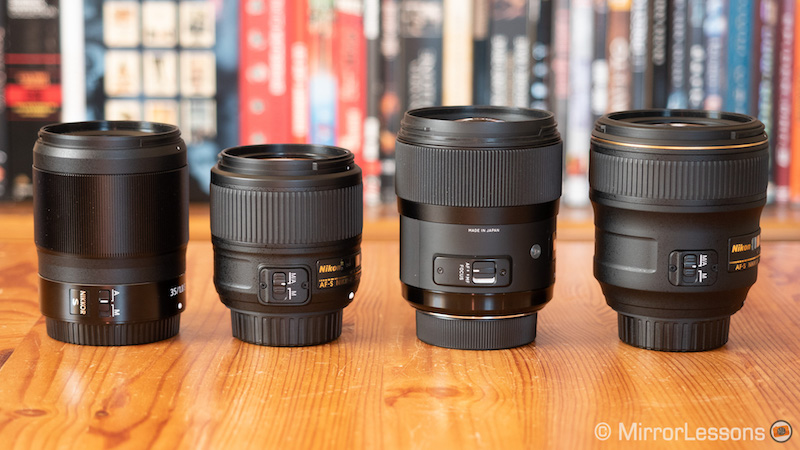
All 4 lenses feature a high-quality structure. The Sigma has a nice all-metal barrel, the Z lens is a mix of metallic and polycarbonate, and the ii Nikkor DSLR lenses are predominantly fabricated of plastic. Their focus rings all feature a ridged design that makes them easier to take hold of and turn only the grooves on the Z lens are shallower.
On the side of the barrel of each lens, you'll find an AF/MF switch that lets yous jump between autofocus and transmission focus more rapidly than if you entered the menu. The three DSLR lenses also feature a focus distance scale which is found within a small window on the barrel.
Boxed along with each lens is a petal-shaped lens hood to help protect the front element and a clip-on lens cap.

Each lens also features its ain lens coating to reduce flare and ghosting.
Optical quality: Sharpness
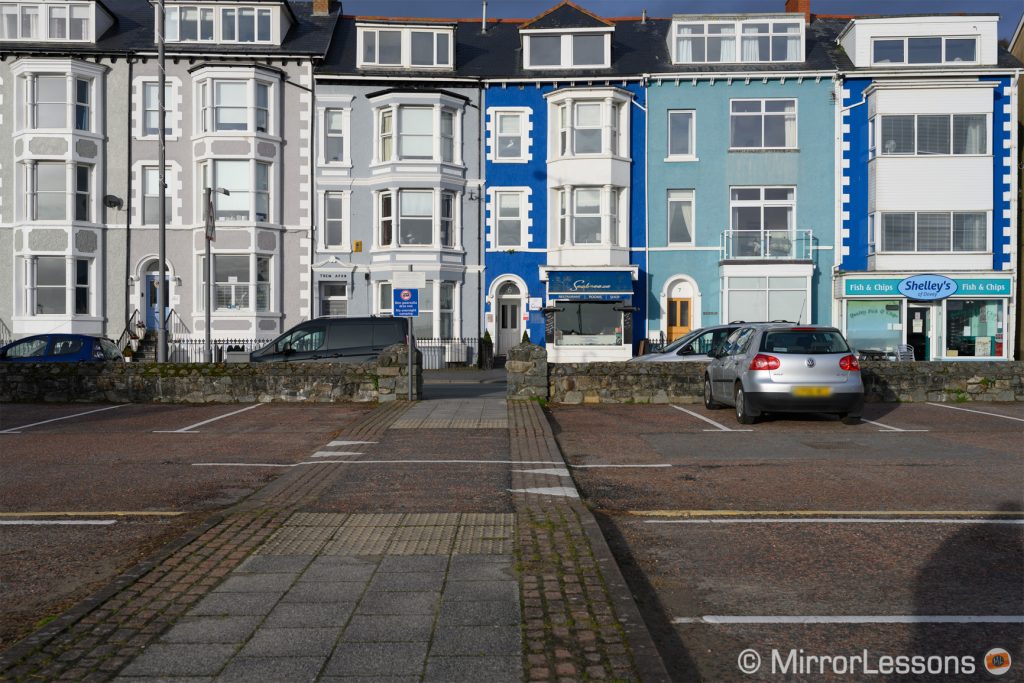
Sharpness is one of the aspects potential users of the Z 35mm will be most interested in since Nikon has placed such a heavy focus on the superior optical quality of its new lenses. Let's meet whether at that place is a tangible difference when we compare information technology to the iii DSLR lenses.
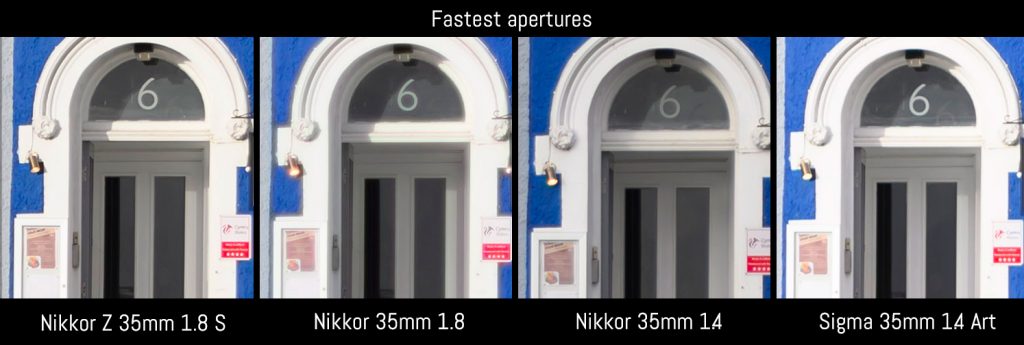
At the fastest apertures, the 35mm i.8 M lens is conspicuously the softest of the four. The other three look quite similar overall. (Notation that the deviation in dissimilarity is due to slight changes in the low-cal conditions.)
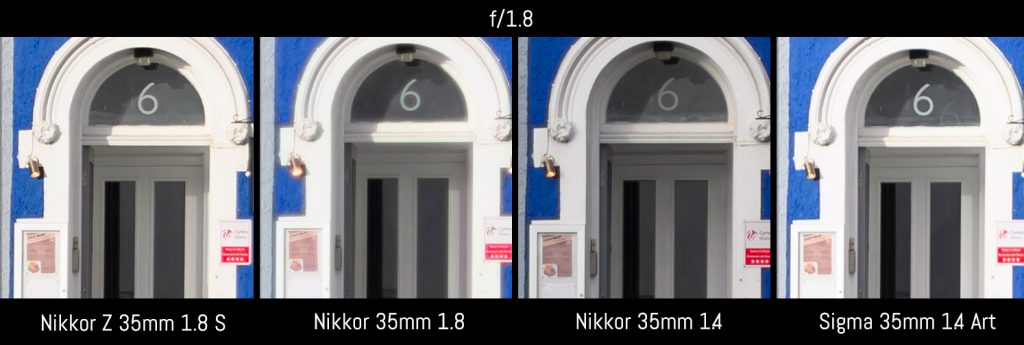
At f/one.eight and f/2, the Sigma and Nikkor 35mm 1.4 sharpen upwards a little only the Z lens appears to be the sharpest overall.
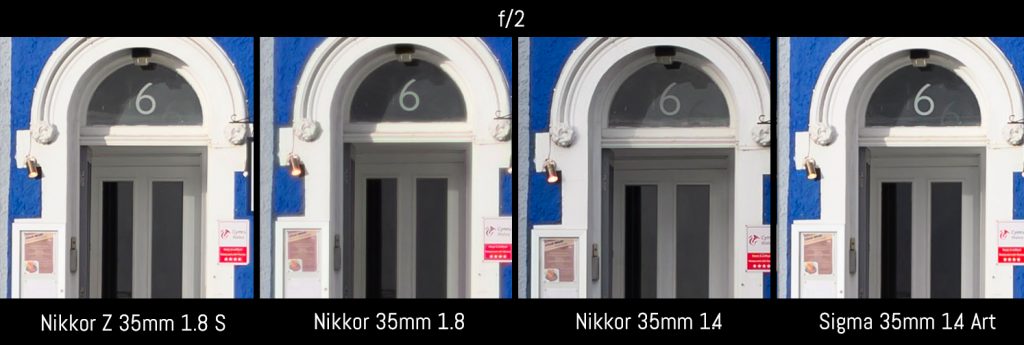
By stopping down to f/ii.viii, all four lenses including the 35mm 1.8 G become much sharper. At this value and beyond, it is quite difficult to tell the difference between them. All four are at their sharpest between f/4 and f/8 whereas diffraction just becomes noticeable at f/16.
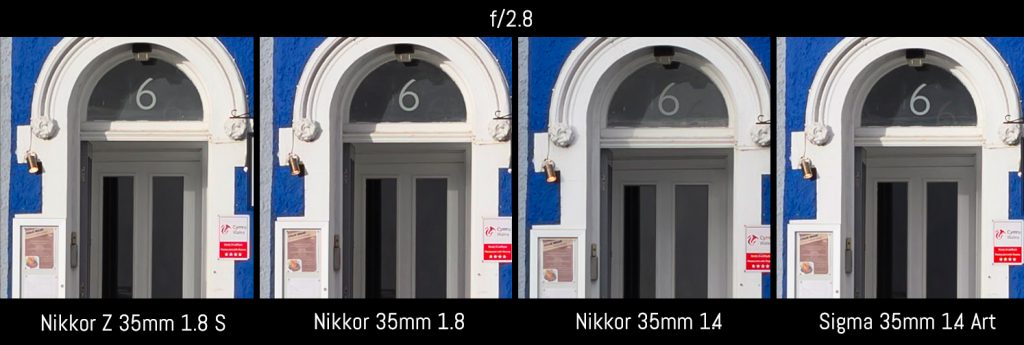
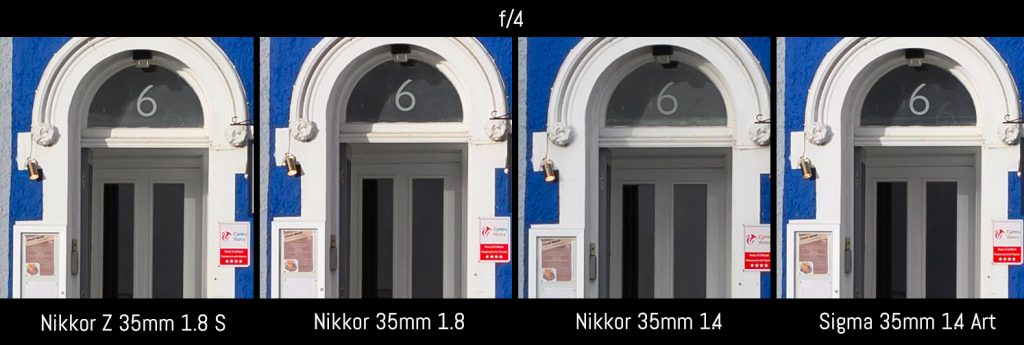
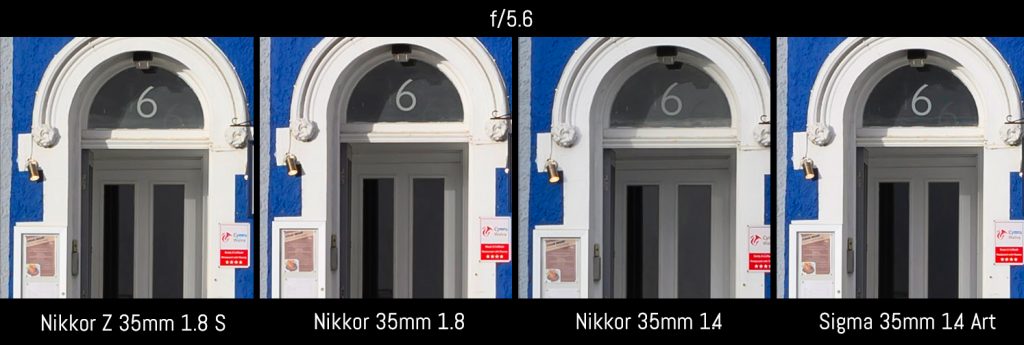
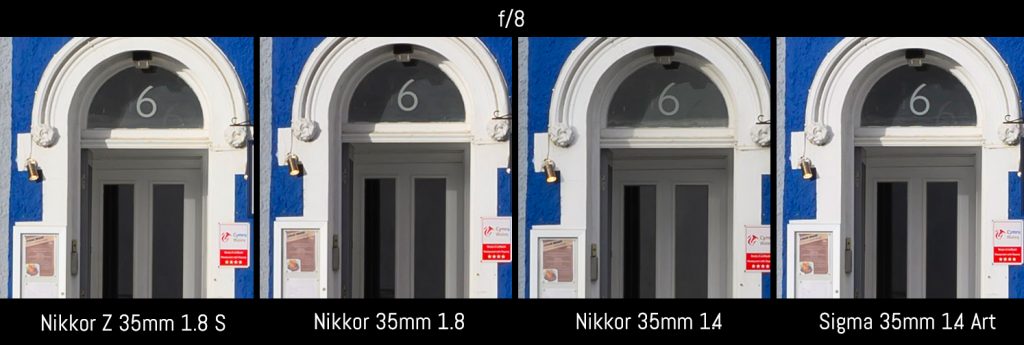
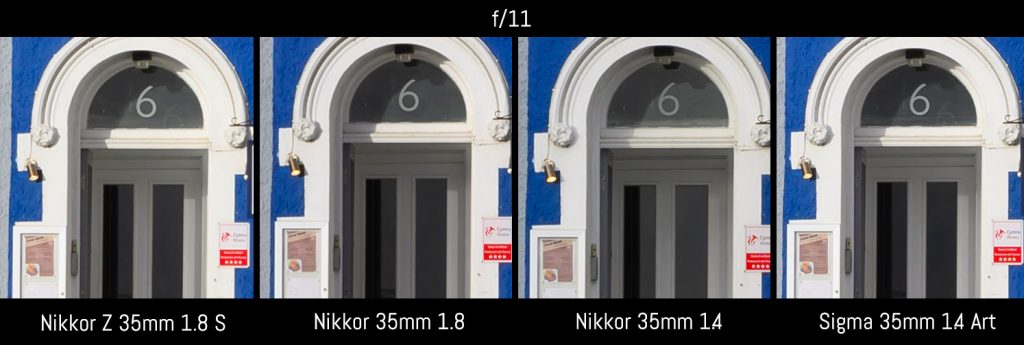
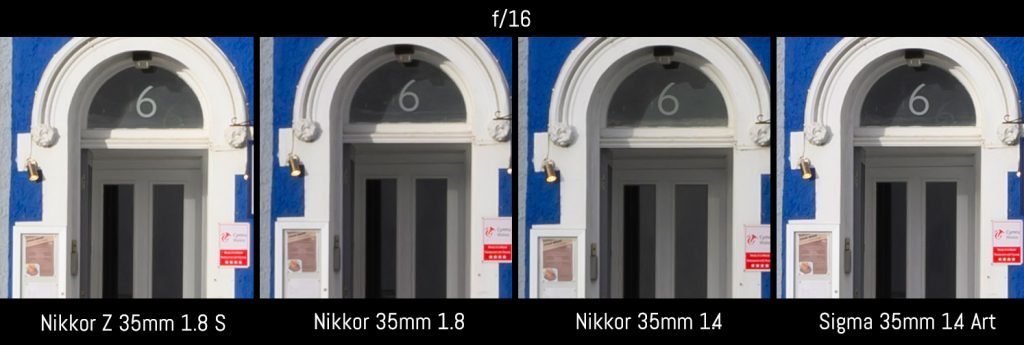
Looking at the above examples, we tin't really say that the Z lens has an advantage over its siblings at the middle in terms of sharpness. It is only past turning to the corners that we start to see some differences worth investigating.
At the fastest apertures, the Z lens is impressively precipitous compared to the other three lenses. The second sharpest is the Nikkor 1.four followed past the Sigma and the Nikkor 1.8.
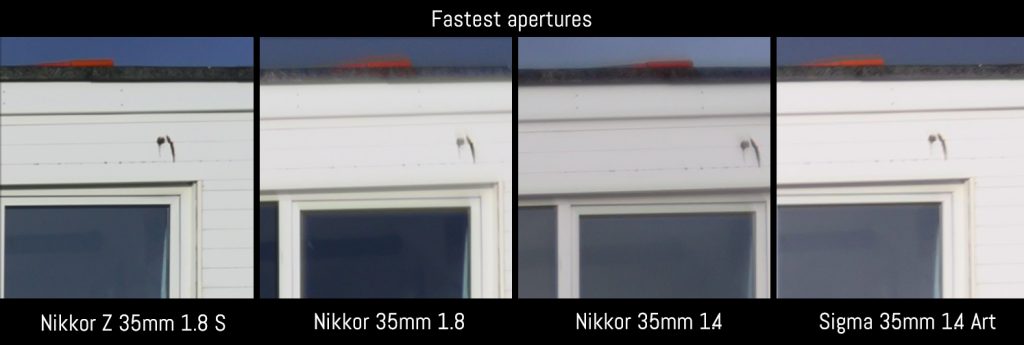
It isn't until f/2.eight that we start to see an comeback from the three DSLR lenses, merely however, the Z lens continues to outperform them.
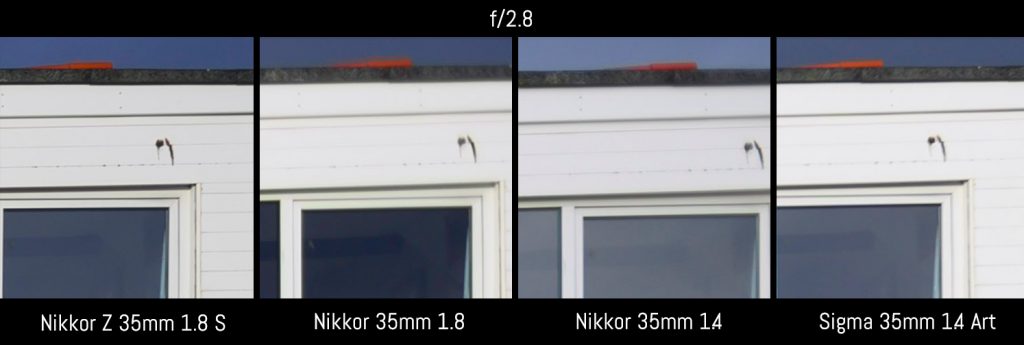
The simply fashion to have similar results with all four is to end down to f/5.half-dozen.
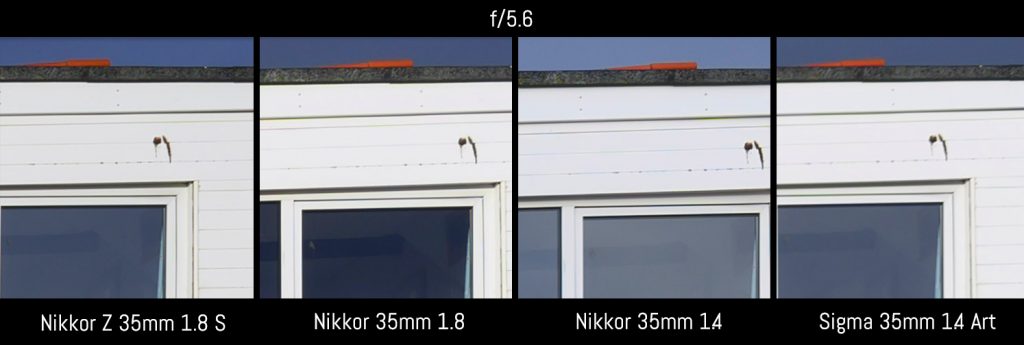
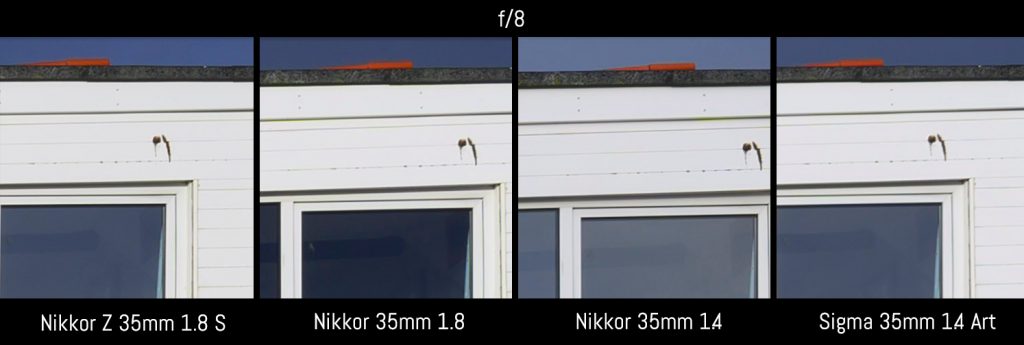
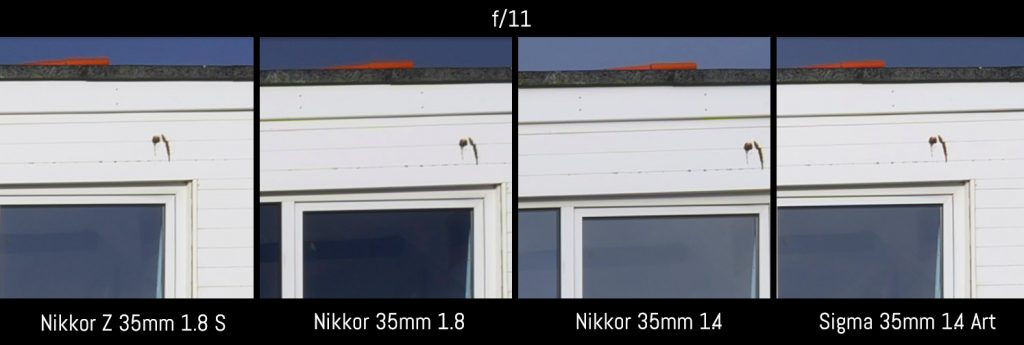
Between f/8 and f/16, all iv continue to look quite similar. Diffraction begins to evidence at f/11 but is most evident at f/xvi.
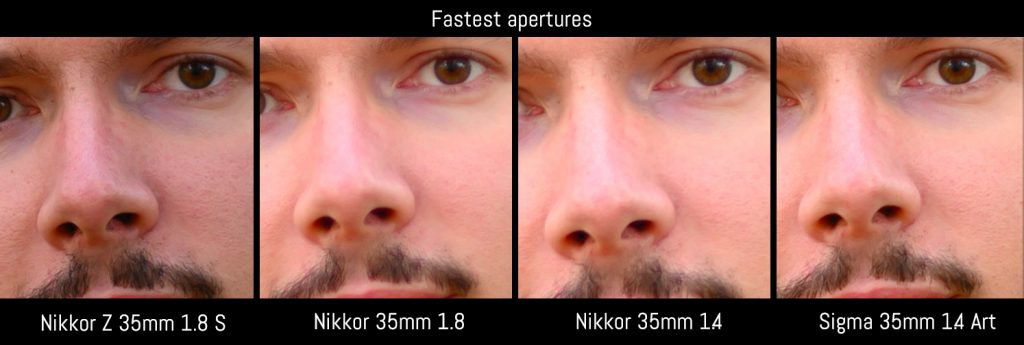
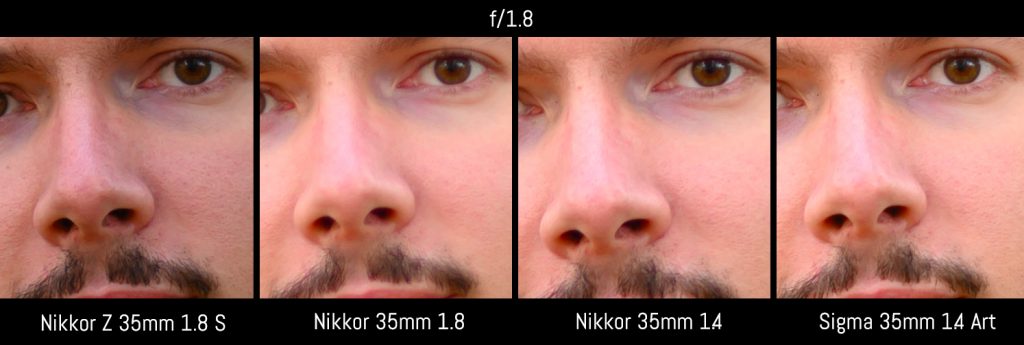
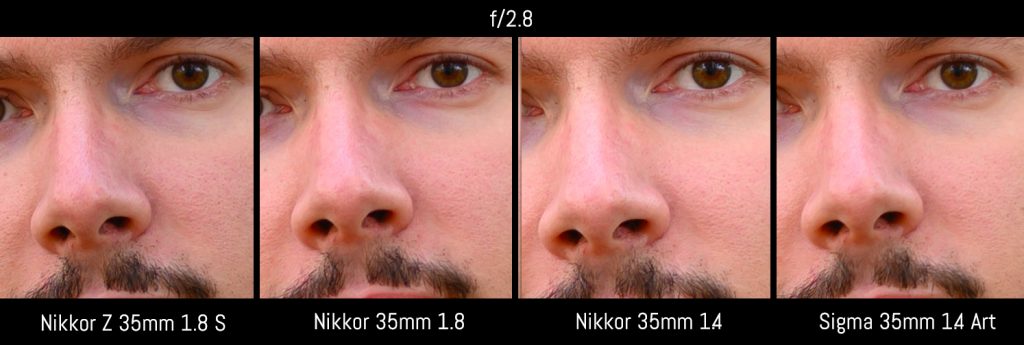
At present let's take a quick look at how they perform between the fastest values and f/2.viii on a subject situated approximately two meters away from the camera.
Once again, the 35mm 1.8 Yard is the softest of the three at the fastest apertures and f/one.8. I would too say that the new Z lens looks always and then slightly sharper than the 2 1.four lenses.

When stopped downwards to f/2.8 even so, they all look extremely similar.
Minimum focus distance
The two 1.8 lenses both have a minimum focus altitude of 25cm whereas the 1.4 lenses can focus as shut as 30cm. The 35mm 1.eight G has the highest magnification (0.24x), followed past the Nikkor 1.four (0.20x) and finally the Z lens and the Sigma (0.19x).
The real world results reflect the magnification statistics higher up: the 35mm 1.viii Thou allows you to become the closest, whereas the other 3 lenses look much more similar.
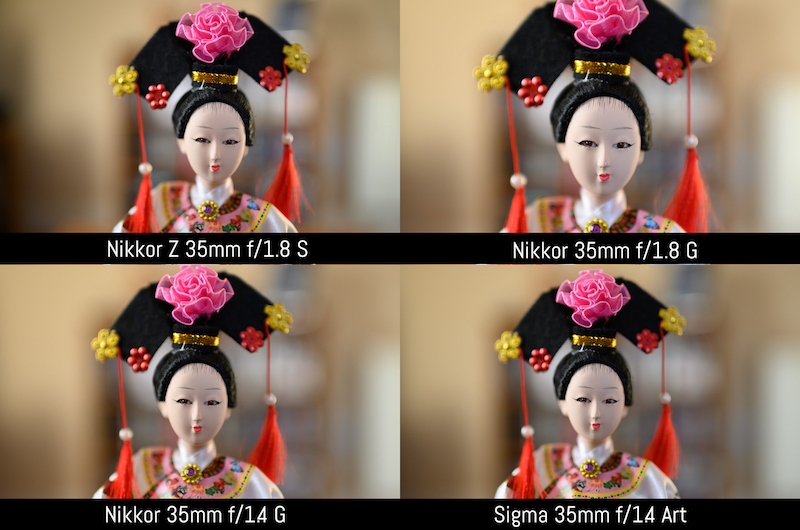
It is also worth noting that all three DSLR lenses exhibit focus breathing to some caste, whereas the new Z lens hardly suffers at all.


Optical Quality: Bokeh and other characteristics
Bokeh and depth of field
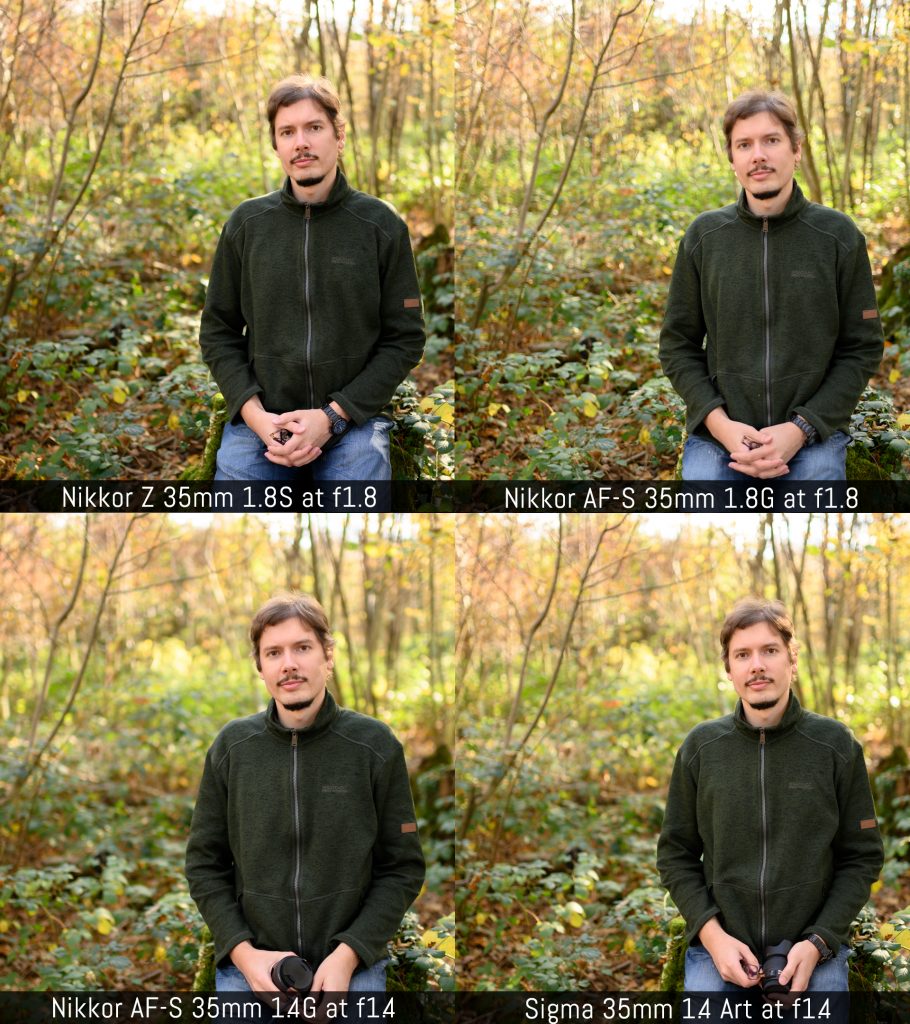
Bokeh is a term used to describe the quality of the out-of-focus areas of an image. As we tin can see from the crops below, the graphic symbol of each lens' bokeh is quite dissimilar at their respective maximum apertures.
The 35mm 1.8 K lens has the to the lowest degree pleasant bokeh of the four. In addition to being quite nervous, the specular highlights also exhibit quite a lot of unpleasant fringing that isn't piece of cake to eliminate. The bokeh of the Z lens is somewhat nervous as well simply it displays much less fringing than its less expensive counterpart.
The two 1.4 lenses are definitely smoother and more blurred in the groundwork than either 1.8 lens, and also display less fringing. At their shared maximum value, they likewise provide greater subject separation than the ii 1.8 lenses. Of all four lenses, I'd say the Nikkor i.4 has the virtually pleasant bokeh due to the extremely smooth rendering and almost-complete lack of fringing around the out-of-focus areas.
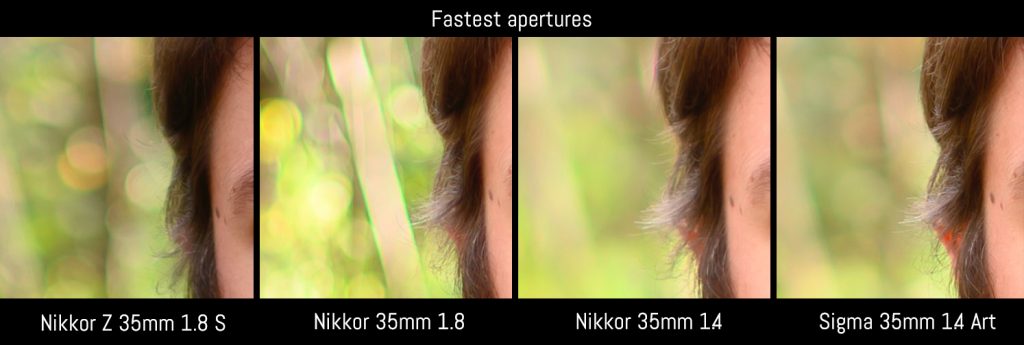
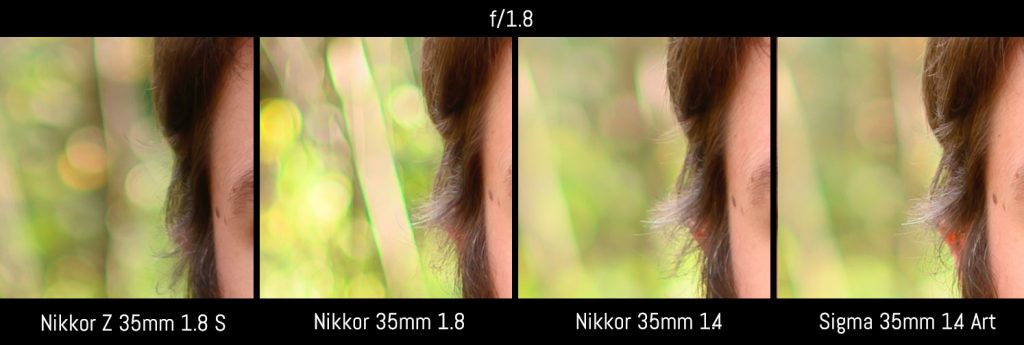
If you lot stop the two one.4 lenses down to 1.8, the Nikkor starts to wait much more like the Sigma.
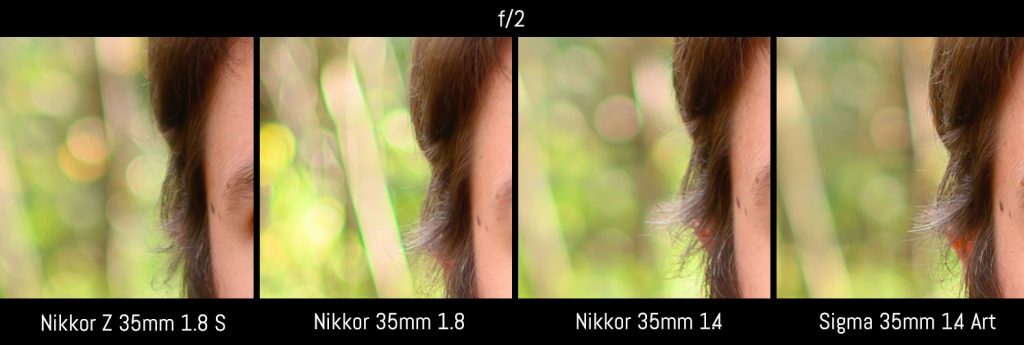
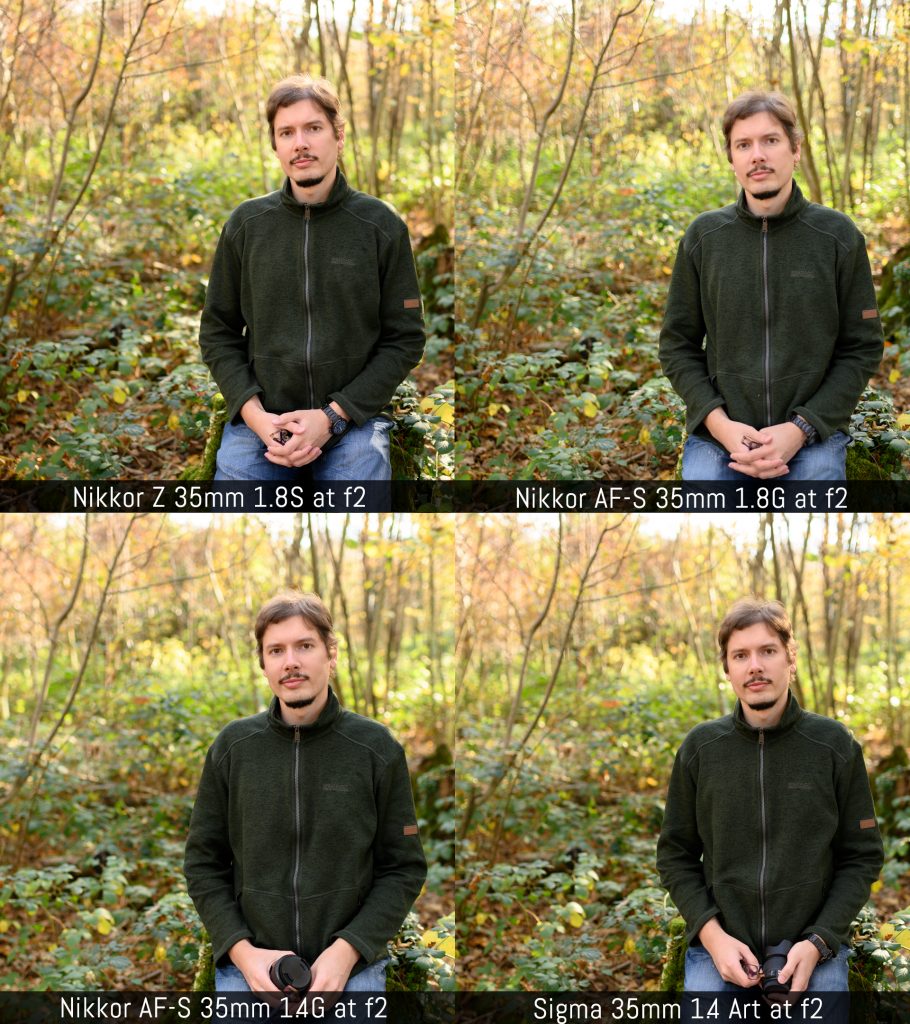
At f/2, you start to clearly run across bokeh balls emerge in the examples taken with the ane.4 lenses. They both look quite like to the Z lens at this value, whereas the one.eight Chiliad continues to deliver an unpleasant and busy bokeh.
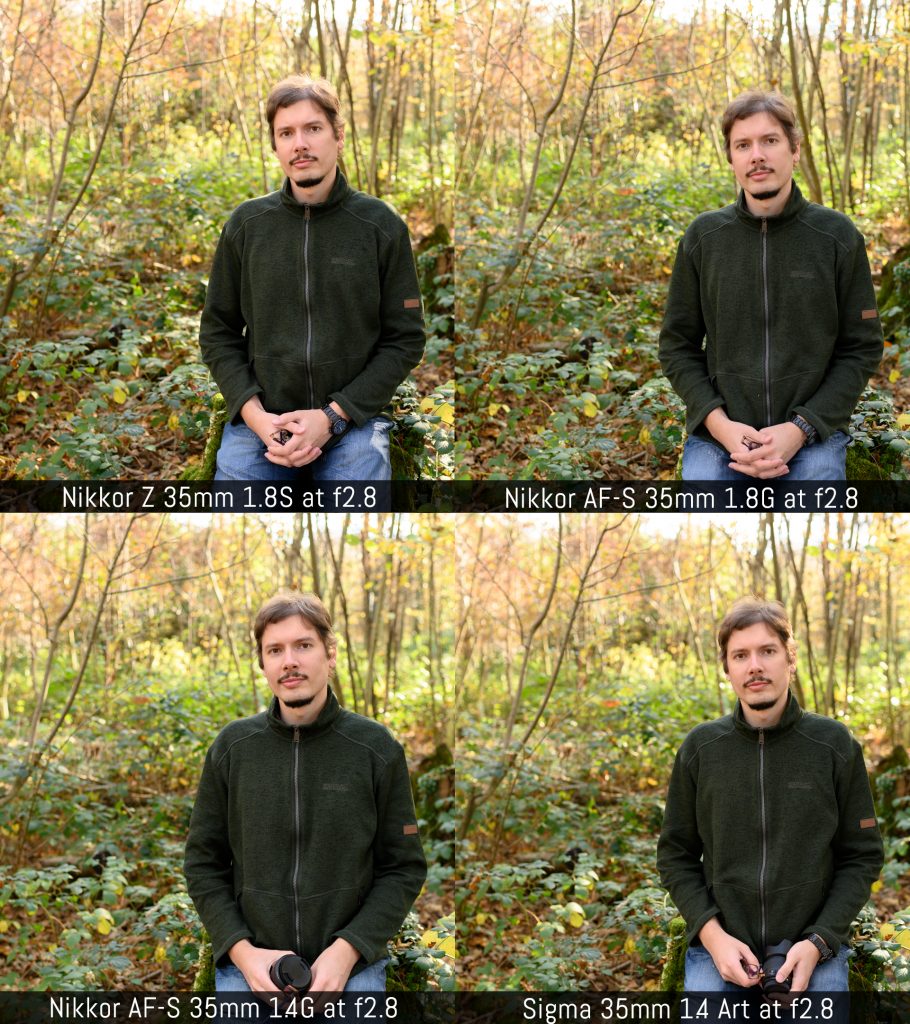
Finally at f/two.eight, all four lenses have a much busier look due to the slower aperture. All iv display some bokeh fringing simply it isn't virtually every bit severe from the 35mm 1.viii G lens. The Sigma lens seems to suffer from bokeh fringing the least.
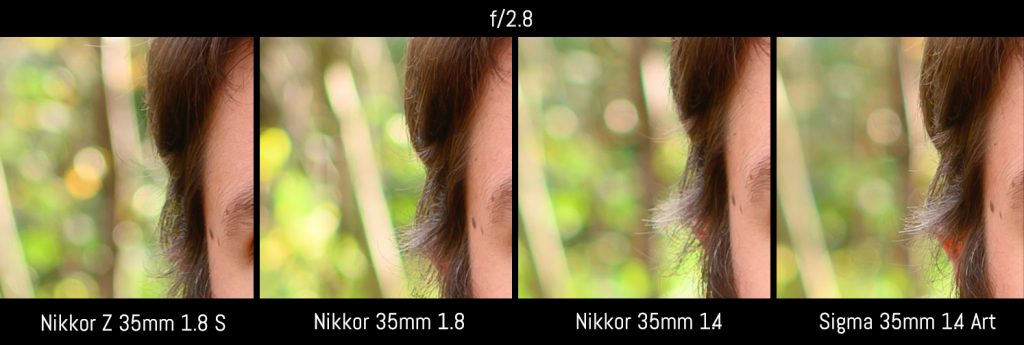
In short, I feel the Nikkor 1.4 wins in terms of bokeh rendering, which makes sense given its price. It is closely followed by the Sigma whose bokeh is very similar at ane.8 but isn't quite as shine and pleasant at 1.four. Both do an equally good chore of separating the subject from the background thank you to their fast maximum discontinuity.
The Z lens has a decent bokeh simply I observe it somewhat busier than I'd hoped at 1.8. As for the 35mm 1.viii G, I wasn't impressed but to exist off-white, it too costs less than the three lenses nosotros're comparing it confronting!
Below you tin see some examples of bailiwick separation.
Distortion and vignetting
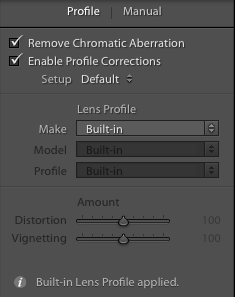
Nikon Z7 RAW files comprise a congenital-in lens contour that does a skillful job of correcting distortion for all 4 lenses mentioned here, and so you lot don't need to manually utilize the profile when you import the files into a post-processing software like Lightroom.
Vignetting correction is also applied to the RAW file but you may nevertheless notice some corner shading at the fastest apertures. On the Z lens, it is present upwardly until f/ii.8 whereas with the other lenses, it disappears at around f/5.6.
For the OOC JPGs, y'all tin can arrange Vignette Command in-camera past selecting between iv different strengths (High, Normal, Low and Off). There is also an Machine Baloney Control selection which you can turn on to reduce barrel distortion. (Annotation that with the Z lens, this option cannot be turned off and will therefore exist greyed out and unavailable.)
Flare
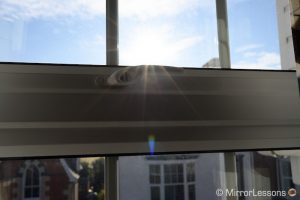
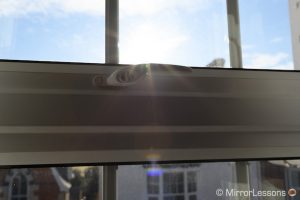
All four lenses exhibit some very pocket-sized flare and ghosting in scenes with bright sources of light every bit you tin can see from the examples beneath.


Chromatic aberration
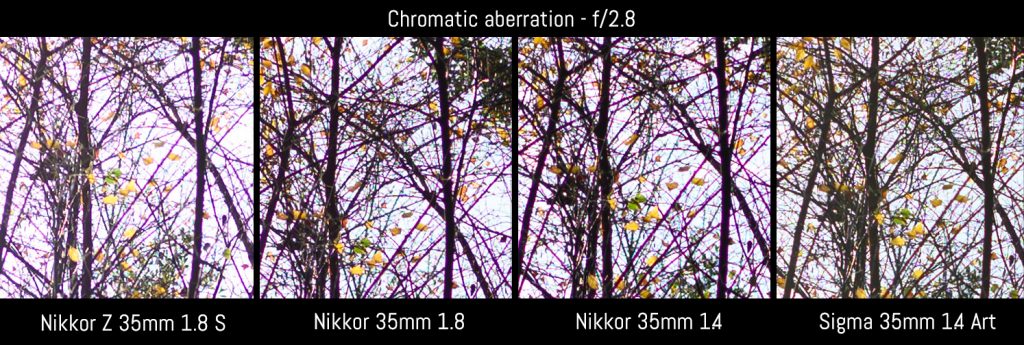
All four lenses suffer from chromatic aberration at the fastest apertures in both the middle and in the corners.
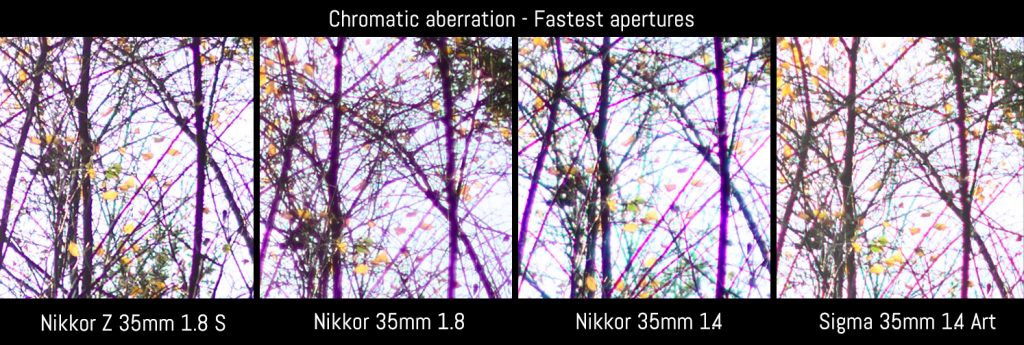
The Sigma suffers the least, showing signs until f/two.eight, whereas with the other four, yous have to stop downwards beyond f/4 for it to disappear entirely. You can rely on the dedicated CA removal tool in your post-processing software of choice to eliminate the worst of it.
Focus
Autofocusing
When comparing the four lenses in S-AF for stills, information technology presently became clear that the Z 35mm is the fastest and quietest of the 3. The three DSLR lenses are also very quick but the AF motor is more aural, specially in the case of the ii 1.4 lenses.
For video in C-AF, the Z lens is once again the fastest of the iv and is also deadly silent. The other lenses are a footling slower and somewhat noisier than the native lens: the Sigma is the loudest whereas the 2 Nikkors make a faint crunching sound as they switch from one focus point to some other.
Manual focusing
Equally mentioned above in the design section, all four benefit from a ribbed ring for transmission focusing. Those of the DSLR lenses are rubberised and have deeper ridges whereas the band of the Z lens is made of metal and has shallower ridges that are bunched more closely together. When the camera is in autofocus way, the focus band of the Z 35mm becomes a control ring to which yous tin can assign exposure compensation or aperture changes.
Unlike the F-mount DSLR lenses, which offer traditional mechanical control over focusing, the new Z 35mm features a "focus-by-wire" machinery whereby focusing is performed electronically. The only tangible difference we noticed is that the Z lens is smoother and moves more freely than the rings of the DSLR lenses. In terms of accuracy, all four were easy to utilise on the Z7 when magnification was activated.
When you hit either the minimum focus altitude or infinity with the two Nikkor DSLR lenses, you lot volition run across some slight resistance at both ends. You can continue to turn the ring even when it reaches either farthermost but the focus will no longer change.
Conclusion
When Nikon announced the Z arrangement, they placed a lot of accent on the superior optical quality of their new generation of lenses. The new Z 35mm ane.8 S doesn't disappoint simply doesn't impress either. Although it offers sharper results in the corners when set at the fastest apertures, centre sharpness is more than or less identical to the two ane.four DSLR lenses.
The matter is, expert corner sharpness wide open merely really matters for very specific genres such as astrophotography or specific kinds of depression-light events. So unless this particular characteristic is important to you, it may make more than sense to invest in the FTZ adapter for the time being and continue using whichever 35mm lens you take in your collection (if you're already a Nikon user, that is).
But what if yous aren't already invested in the Nikon DSLR arrangement? In this instance, I would recommend the native Z lens over both Nikkor DSLR lenses. Paired with the FTZ adapter, the Nikkor 35mm 1.8 Thousand is nearly the same cost equally the Z lens (just under $800), yet offers inferior optical quality, whereas the Nikkor 1.iv lens will cost y'all shut to an eye-watering $2000.
In our opinion, the only logical substitute for the Z lens is the Sigma 35mm 1.4, whose $1150 price tag (with the adapter) is justified by the faster aperture and nicer bokeh. But let'south non forget that the Z lens brings with it some advantages that none of the DSLR lenses offering, such as a lightweight design and faster/quieter AF motor.
Cull the Nikkor Z 35mm i.8S if yous:
- are brand new to Nikon and don't already ain a 35mm for the F-mount
- need a fast and placidity AF motor
- want the about compact and lightweight 35mm lens possible
Choose the Nikkor 35mm 1.8G if yous:
- want to spend as little every bit possible (simply keep in listen that the price of this lens isn't all that different from the native Z lens in one case you include the FTZ adapter)
Choose the Nikkor 35mm i.4G if you:
- want the smoothest, nearly attractive bokeh possible (but go on in mind that the Sigma's bokeh is near equally squeamish)
- happen to find information technology at a discounted cost
Choose the Sigma 35mm ane.4 Art if you lot:
- recollect you might use the 1.4 aperture on a regular basis
- want a creamy bokeh without spending a fortune
Cheque the toll of the Nikkor Z 35mm f/1.8 Southward on B&H Photograph
Check the price of the Nikkor 35mm f/1.8 G on B&H Photo
Check the cost of the Nikkor 35mm f/1.4 G on B&H Photo
Check the price of the Sigma 35mm f/1.4 Art on B&H Photograph
Nikkor Z 35mm 1.8S Sample Images







Source: https://mirrorlesscomparison.com/z-mount-lenses/nikkor-z-35mm-1-8s-vs-35mm-1-8g-vs-35mm-1-4g-vs-sigma-35mm-1-4-art/
0 Response to "Sigma 30mm F1 4 Art Vs Nikon 35mm F1 8"
Post a Comment